Most sales tools hand you a list and leave the gaps for a human to close. Autonomous lead fill flips that. It is a self-running engine inside LinkSpear that watches your Local Business Directory, notices which contact cards are missing an email, a phone, an address, or a category, and quietly completes them in the background, without anyone opening a browser tab. You do not queue a job, babysit a spinner, or export a spreadsheet to a data vendor. You set it loose once, and it keeps your directory complete on its own.
This page explains what autonomous lead fill is, how the engine runs step by step, the outcomes you should expect, who gets the most out of it, and how it threads through the wider LinkSpear workflow alongside scraping, lead enrichment, call queuing, and directory backlink building.
What autonomous lead fill actually is
Think of it as the difference between a tool you operate and a tool that operates itself. Traditional enrichment is something you trigger: you select records, press a button, and wait for a run to finish. Autonomous lead fill removes you from that loop entirely. It is a continuous background process that treats an incomplete contact card as a task to be resolved, and resolves it, then moves to the next one, indefinitely.
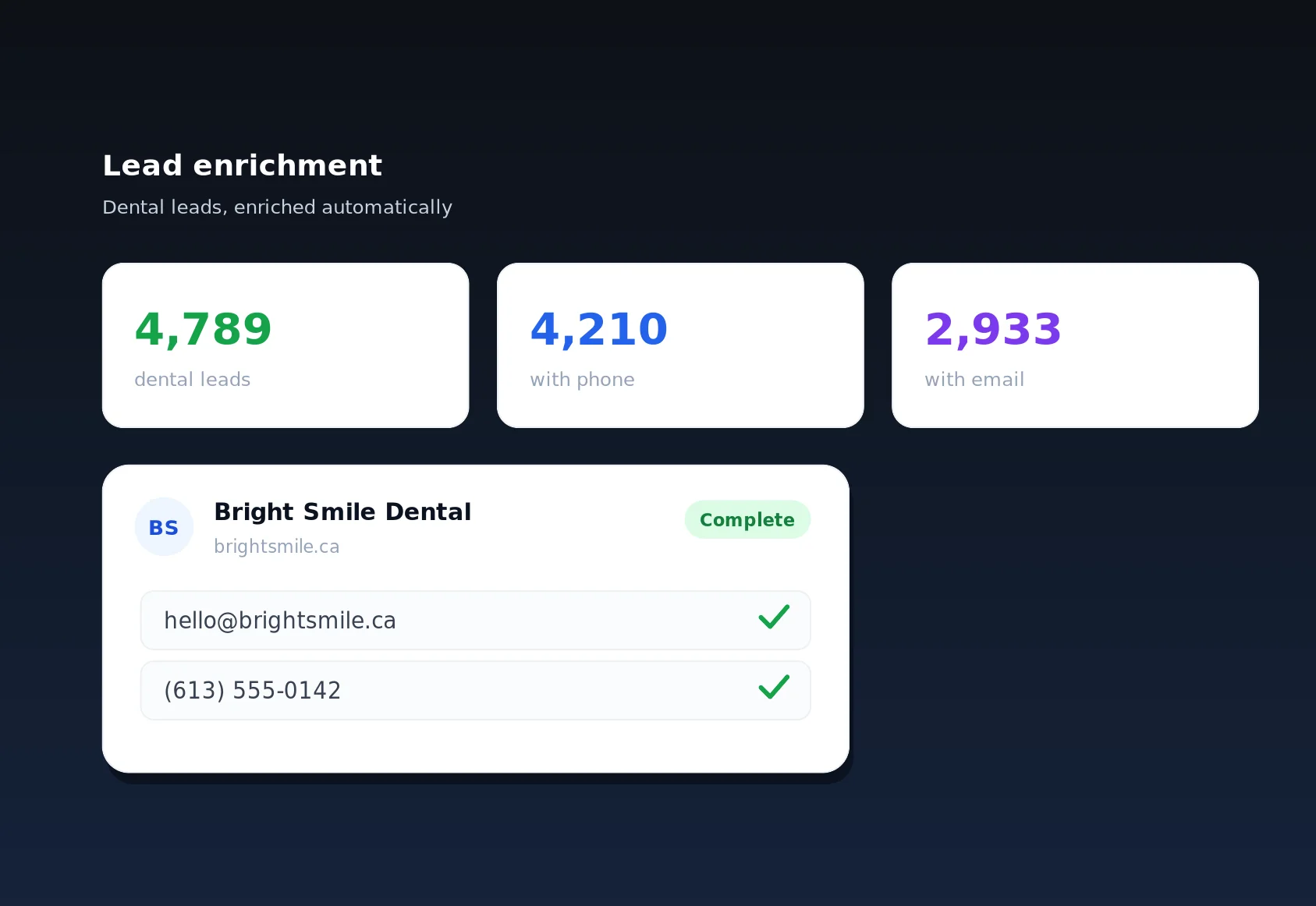
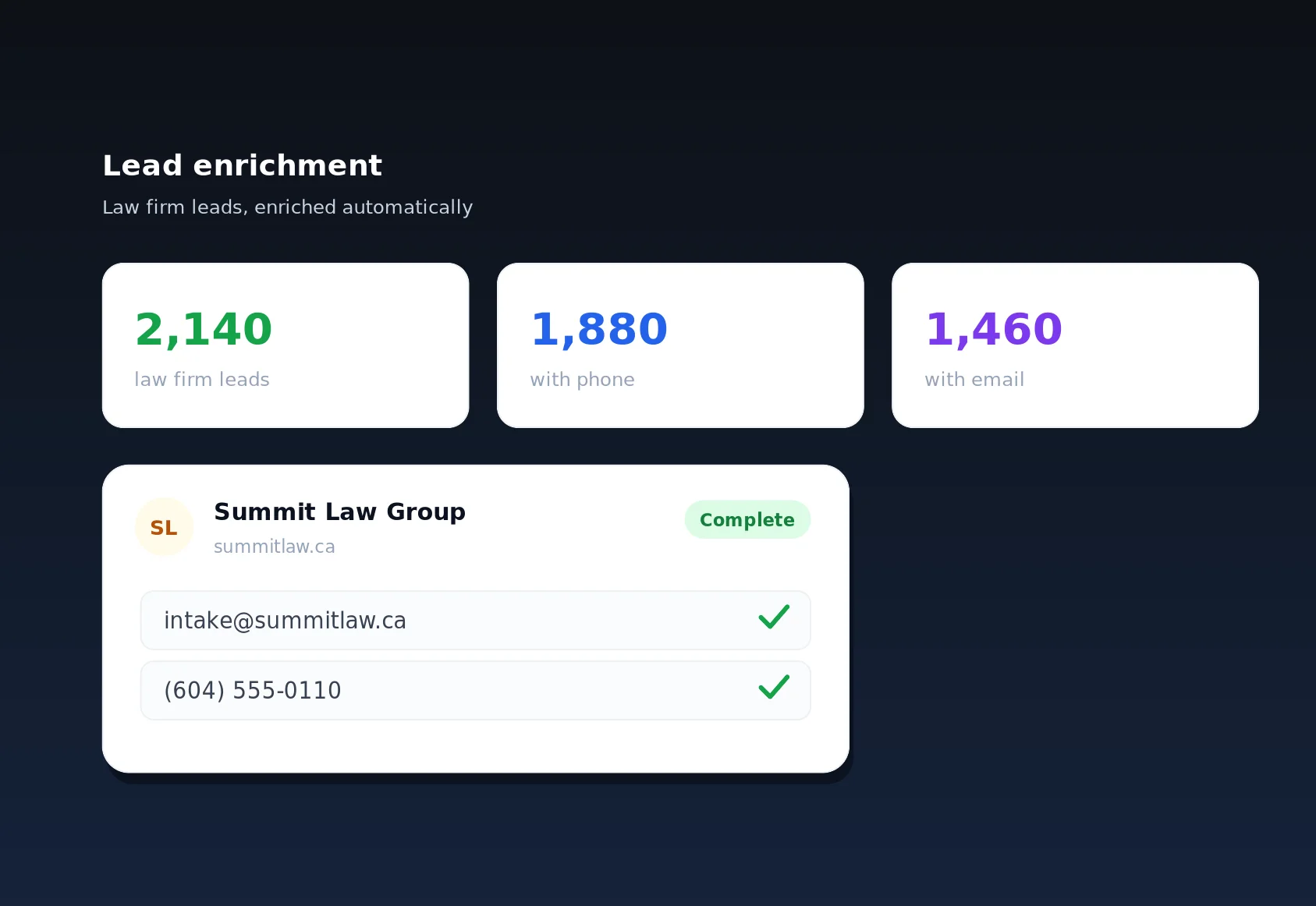
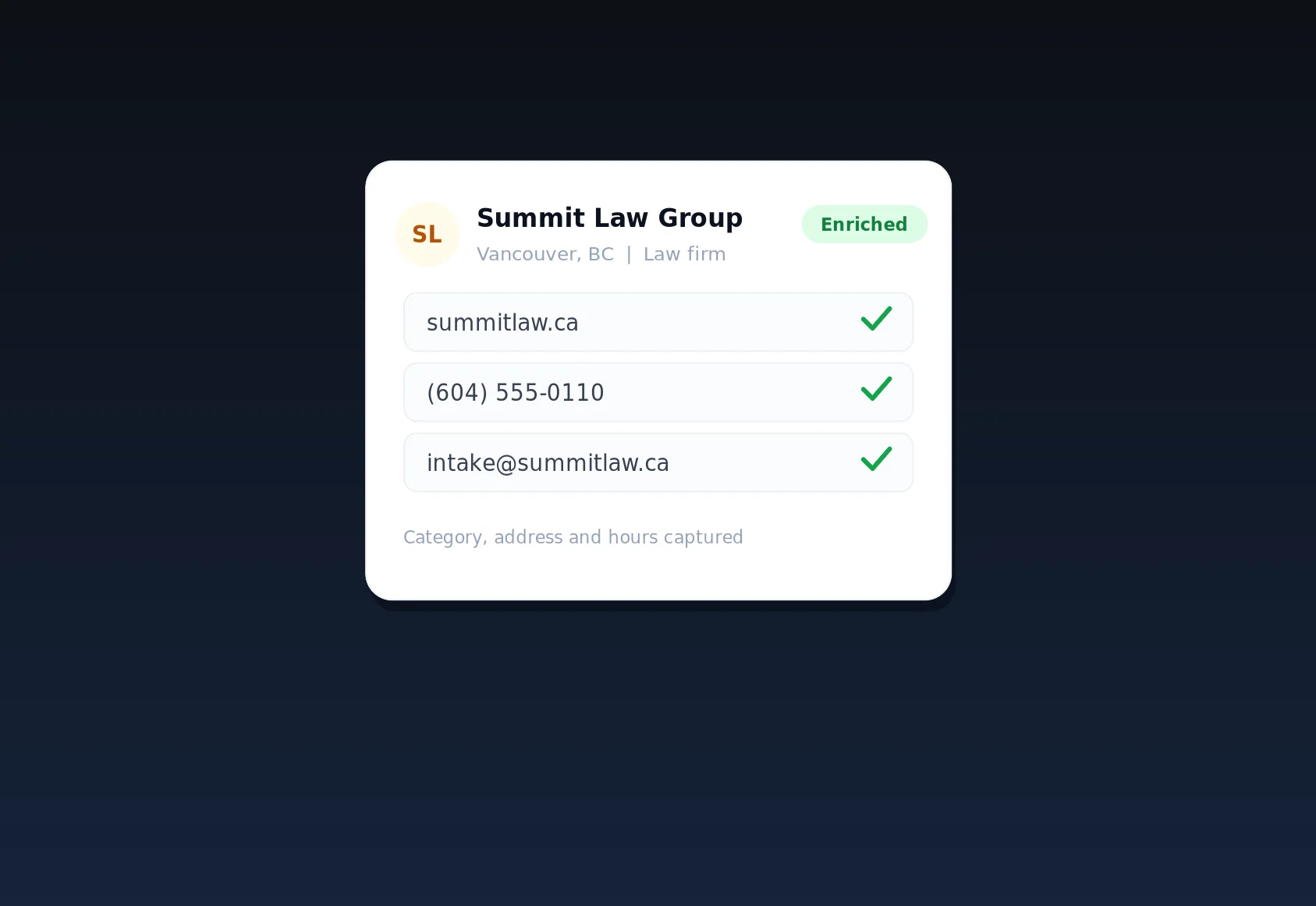
A complete card in LinkSpear carries the business name, phone, email, website, street address, city, province or state, country, and category. When leads arrive from scraping or import, several of those fields are usually blank. The autonomous engine's single job is to drive that blank count toward zero across your whole directory and to keep it there as new leads flow in. It is less a feature you run and more a standing policy: every workable record should end up complete.
Crucially, the data it writes comes from each business's own live website, not a stale purchased database. The engine reads the pages a diligent rep would read and extracts the contact details the business itself has published. That keeps every filled field current, because it mirrors what the company shows the world today rather than what a broker logged eighteen months ago.
How it works, step by step
The engine runs as a persistent background worker against your deduplicated Local Business Directory. Here is the loop it repeats.
1. Watch for incomplete records
Instead of waiting for you to press a button, the engine continuously scans the directory for cards missing an email, phone, address, or category but carrying a valid website URL. New leads from scraping enter this watch list automatically the moment they land, so nothing sits incomplete waiting for a human to notice.
2. Route every visit through an anonymous proxy
Each website visit is made through a rotating pool of anonymous proxies. Your own IP address never touches the target site. That protects you two ways: you avoid being throttled or blocked after a handful of requests, and you never leave a footprint that ties bulk visits back to your business or agency. The system is fail-closed, so if no proxy is available it waits or retries rather than quietly falling back to your real connection.
3. Read and parse the site
The engine loads the homepage and the pages most likely to carry contact details, typically the contact, about, and footer areas, then parses the markup for published emails, telephone numbers, postal addresses, and structured contact schema. It handles the formats businesses actually use, including mailto: and tel: links, plain-text listings, and JSON-LD contact blocks.
4. Validate, normalize, and categorize
Extracted values are cleaned before they are saved. Phone numbers are normalized to a consistent format, placeholders and image artifacts are discarded, and email addresses are checked for sane structure so tracking pixels and junk like [email protected] never land on a card. Where the category is missing, the engine infers it from the site's own signals so the record is filterable by vertical.
5. Write back to the contact card
Clean, validated values are written to the matching record in your directory. Existing good data is preserved; the engine only fills empty fields unless you explicitly ask it to refresh. Every touched record is timestamped, so you can always see when it was last completed and what changed.
6. Loop, and hand off downstream
A newly completed card becomes immediately eligible for call queuing, so a rep can dial it, or for a citation submission through the backlink extension. Then the engine simply moves to the next incomplete record. Because it never stops watching, the directory trends toward complete on its own.
Autonomous versus on-demand: what changes
LinkSpear also offers on-demand lead enrichment that you trigger manually against a selection of records. Autonomous lead fill uses the same reading-and-validating engine underneath, but changes the operating model from something you run to something that runs itself. The distinction matters more than it sounds.
| Dimension | On-demand enrichment | Autonomous lead fill |
|---|---|---|
| Who starts it | You, per batch | Nobody, it runs continuously |
| New leads | Wait for the next manual run | Picked up automatically on arrival |
| Attention required | Select, trigger, monitor | Set once, then ignore |
| Directory state over time | Complete right after each run, drifts after | Trends toward complete and stays there |
| Best for | One-off list clean-ups | Live, growing prospect books |
| Fields filled | Email, phone | Email, phone, address, category |
| IP exposure | Anonymous proxies | Anonymous proxies |
If your list is static, on-demand enrichment is fine: run it once and you are done. But the moment your list is alive, with new leads scraped weekly and old ones being worked, a manual run is always chasing yesterday's gaps. Autonomous lead fill closes them as they appear, so completeness stops being a task you remember to do and becomes the default state of your data.
Why autonomous lead fill relies on anonymous proxies
Any tool can claim to complete leads. The detail that separates a pipeline that runs reliably for months from one that stalls after fifty lookups is how it makes the actual web requests. Because autonomous lead fill runs continuously, this matters even more than it does for a one-off batch: the engine may make thousands of visits a day, every day, and it has to stay invisible the whole time.
- No IP leakage, ever. The target website sees proxy IPs, never yours. An agency completing leads for dozens of clients around the clock stays completely anonymous.
- Sustained completion rates. Because requests are spread across a rotating pool, the engine is far less likely to be throttled or blocked, so it keeps filling records instead of grinding to a halt.
- Fail-closed by design. If a proxy is unavailable, the request waits or retries. Your real connection is never the backup plan, so a background process running unattended can never accidentally expose you.
This is the same anonymity philosophy that runs through LinkSpear, applied deliberately per task. Lead fill protects your IP with proxies because it is reading other people's sites at volume; the directory backlink builder takes the opposite stance, using your real browser and real IP so citation submissions look like a genuine human filling in a form. Each tool wears the network posture that makes its own job safest.
The concrete outcomes you can expect
Autonomous lead fill is not a data-hygiene nicety. It changes the shape of your team's day and the economics of your outreach.
- Reps sell instead of search. No one tab-hops hunting for a phone number. They open the queue and dial. A rep who saved even three minutes of digging per lead reclaims hours across a week, and those hours go into conversations.
- The queue is never starved. Because completion happens the moment leads arrive, there is always a supply of call-ready cards. New scraped leads do not sit in limbo waiting for a manual enrichment run.
- Higher connect rates. Direct emails and correct phones mean fewer dead ends and fewer generic
info@catch-alls that never get read. - A bigger usable list. Records you previously could not contact quietly become live prospects while you focus elsewhere.
- Faster ramp for new hires. A new rep handed complete cards dials on day one instead of learning your ad-hoc process for tracking down a contact.
- Completeness you can measure. Because every card is timestamped, you can watch the share of your directory that is callable climb week over week instead of guessing at it.
Put those together and the win is structural, not incremental. The single most expensive activity on a sales floor is a skilled rep doing unskilled data-gathering. Autonomous lead fill deletes that activity from the day and leaves the selling behind.
Why freshness beats raw volume
A common instinct is to chase the biggest possible list. In local outreach the opposite usually wins: a smaller list of currently accurate contacts outperforms a huge list of mostly stale ones. Bounced emails erode your sending reputation, and disconnected numbers burn a rep's most limited resource, their calling hours. Because the engine reads the live site at the moment it fills a record, the phone and email it captures are as fresh as the business's own web presence. You trade volume for reachability, and reachability is what produces conversations.
Who it is for
Autonomous lead fill earns its keep for anyone whose outreach depends on reaching people, and whose list keeps growing.
Local service businesses
If you sell to other local businesses, tradespeople, clinics, restaurants, retailers, the engine turns a stream of scraped listings into a standing call sheet. It pairs naturally with vertical targeting; a supplier prospecting plumbers or dentists can point lead fill at an entire category and let it keep that category complete as new businesses are discovered.
Marketing and SEO agencies
Agencies running outreach for many clients need volume, discretion, and to not be in the loop for routine work. Autonomous fill through anonymous proxies builds complete prospect lists for every client without exposing a single IP, and agency sub-accounts keep each client's data cleanly separated. It runs for all of them at once, unattended.
Cold-outreach sales teams
Teams that live in the dialer benefit most. Feed the engine your raw lead scraping output and it keeps the call queue topped up with complete, ready-to-work records. The reps never see the plumbing; they see a queue that is always full of people they can actually reach.
How it fits the wider LinkSpear workflow
Autonomous lead fill is one stage in a pipeline built so each step feeds the next. A typical flow looks like this.
- Scrape. Pull businesses from OpenStreetMap and YellowPages into your Local Business Directory. Many arrive with a name and website but no contact details.
- Deduplicate. The directory is a deduplicated master catalogue, so the same business never appears five times and you never fill, or call, the same lead twice.
- Fill, autonomously. The engine completes missing emails, phones, addresses, and categories through anonymous proxies, continuously, as records arrive.
- Queue and call. Complete cards flow into call queuing, which hands them to reps one at a time with cross-tenant fairness, cooldowns, and daily call caps.
- Build citations. For clients you take on, the Chrome extension auto-fills directory and citation submissions using your real browser, building directory backlinks with no footprint.
- Track and prove. Rank tracking, live-link verification, and schema audits show the SEO work is landing.
Because the directory is shared across every tool, a record completed once benefits every downstream stage. The phone number filled today is the number a rep dials tomorrow and the number that populates a citation next week. Autonomous lead fill is the connective tissue that keeps raw scraping and real outreach in sync without a human standing in the middle.
Data quality, safety, and control
An engine that runs on its own has to be conservative, and this one is. It never deletes or overwrites verified data on a whim; it fills gaps and preserves what is already good. Every touched record is timestamped so you can audit exactly when and what changed, and coverage is reported inside the app rather than buried in a log. Because visits are proxy-masked and fail-closed, an unattended run that cannot reach the network stops rather than silently exposing your IP.
You stay in control of scope even though the engine runs itself. Point it at a single category, a single city, or your entire directory. Pause it, resume it, or narrow it to a client sub-account. Because it skips records that are already complete, letting it run costs effort only where there is genuinely something new to find, so keeping it on is cheap.
Completeness as a lever you steer
Because the engine writes back into a structured directory, you can treat contact completeness as a number you manage rather than a vague hope. Look at what share of a category is callable, and watch autonomous lead fill drive it up on its own. A team that knows only forty percent of its plumbing prospects have a direct phone can let the engine run and see that climb to eighty and hold there, feeding the newly complete records straight into the queue. Completeness stops being a periodic clean-up and becomes a baseline the system maintains for you.
Common questions teams ask before switching it on
A few practical points come up often enough to address head-on.
What about businesses with no website?
The engine needs a URL to read, so records with no website are skipped rather than guessed at. That is deliberate: LinkSpear would rather leave a field blank than invent a contact that bounces. For businesses without a site, details captured during scraping, often a listed phone, still make the record callable, and you can prioritise those separately in the queue.
Does running continuously cost more?
No. Because the engine skips already-complete records and only spends effort where there is a genuine gap, continuous operation is not the same as constant work. Once your directory is mostly complete, the engine idles until new leads arrive. You pay for your plan, not per record, so scaling from a hundred leads to ten thousand does not change your bill.
Does it respect the sites it visits?
Yes. The engine reads publicly published contact information the way a visitor would, at a measured pace, and spreads requests across a rotating proxy pool rather than hammering any single site. The goal is to gather what a business has chosen to make public, not to overload anyone's server.
Let your list complete itself
A list of websites is not a list of leads, and keeping one complete by hand is a chore that never ends. Autonomous lead fill ends it. It is a self-running engine that reads each business's own site through anonymous proxies, fills in the email, phone, address, and category your reps need, and writes it straight back onto a deduplicated contact card that is ready to call, queue, and cite, continuously, as new leads arrive, without you in the loop. It replaces both the hours of manual tab-hopping and the decay of bought databases with current, validated data that stays complete on its own. New users get a 14-day free trial on the Starter plan, so you can point the engine at a real scraped list, walk away, and come back to a full call queue before you pay anything. Start your free trial and let LinkSpear keep your leads complete for you.