A lead is only as useful as the data behind it. A business name with no phone number is a dead end; a website with no email is a guessing game; a listing with a stale address wastes a rep's whole afternoon. LinkSpear's full contact card builder exists to close that gap. Instead of handing your team a spreadsheet of half-finished rows, it assembles a complete, structured contact card for every local business — business name, phone, email, website, street address, city, province or state, country and category — and keeps it deduplicated against a master catalogue so you never work the same lead twice.
This page explains exactly what the full contact card builder does, how it fills in the fields that are usually missing, the concrete outcomes it drives for sales and SEO teams, and where it sits inside the wider LinkSpear workflow. If you have ever paid for a lead list only to find half the phone numbers disconnected and most of the email columns blank, this is the tool that fixes it at the source.
What the full contact card builder actually is
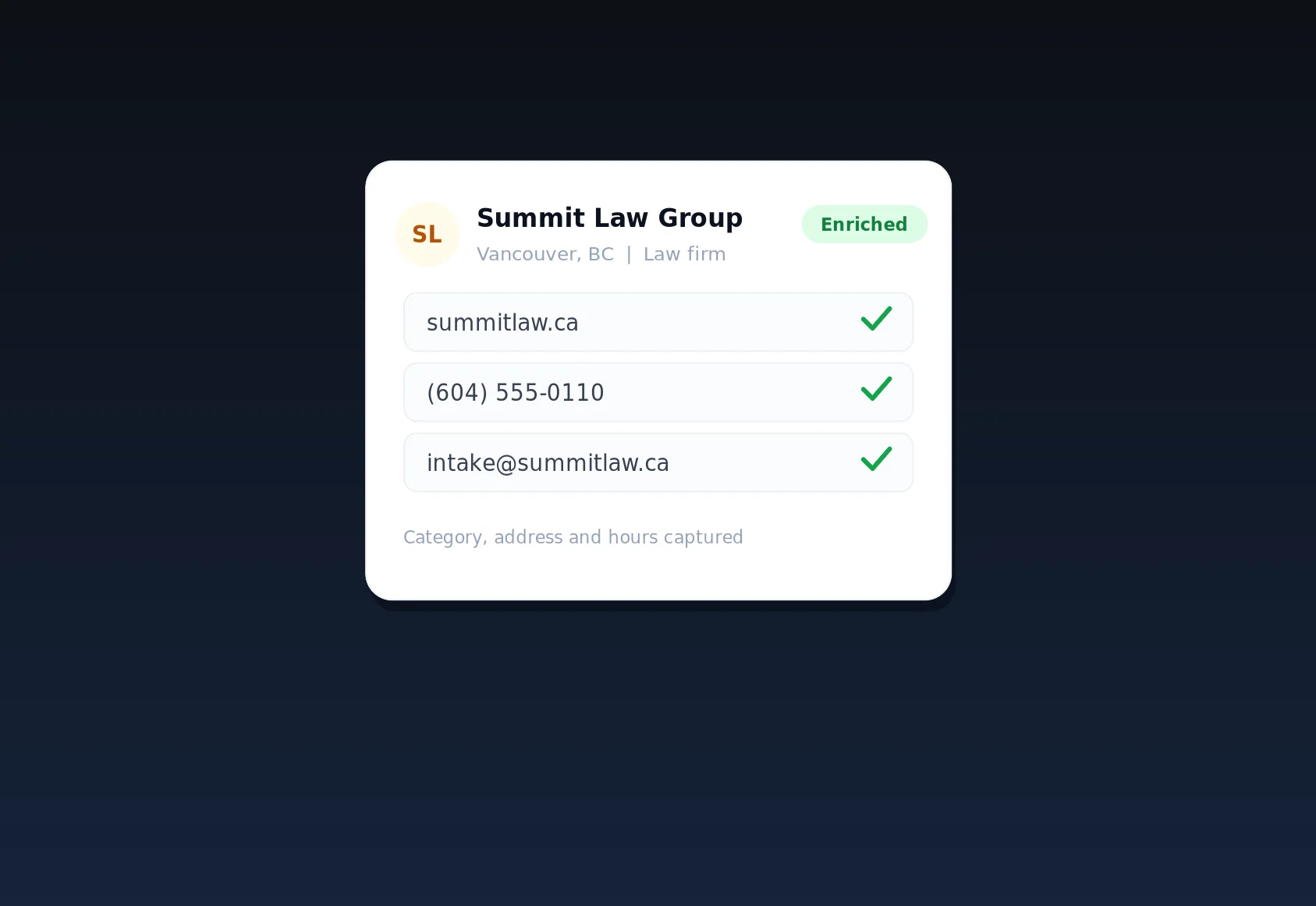
At its core, the full contact card builder is the engine that turns fragmentary business signals into a single, trustworthy record. Raw lead sources are messy: a directory might list a plumber's name and city but nothing else; a map scrape might give you coordinates and a website but no email; a citation site might have an old phone number under a slightly different business name. The builder ingests all of these, reconciles them, and produces one clean contact card that a human can act on immediately.
It is not a static database you buy once and watch rot. It is a live assembly process that runs every time new data enters your account. When a business is scraped, imported or matched, the builder checks what is already known, fills the blanks it can, flags the fields it cannot, and files the result into your local business directory — the deduplicated master catalogue that every other LinkSpear feature reads from.
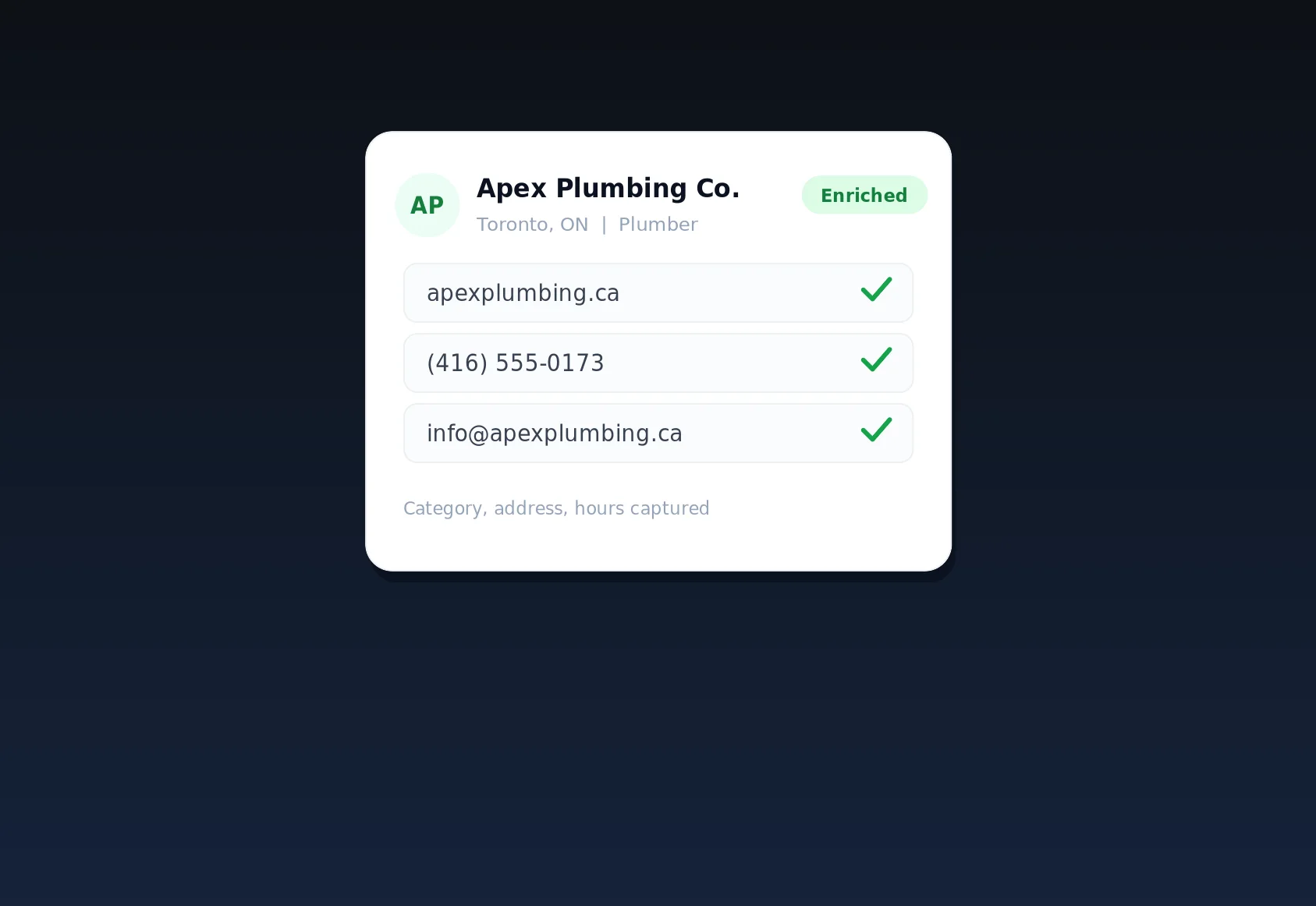
The result is a contact card that looks less like a database export and more like something a diligent assistant spent twenty minutes building by hand: complete, consistent, and ready to call.
The fields on a complete contact card
Every card the builder produces aims to populate the same core fields, so your reps and your automations always know what to expect. A finished card contains:
- Business name — normalised and de-duplicated, so "Joe's Plumbing", "Joe's Plumbing LLC" and "Joes Plumbing" collapse into one record.
- Phone — the primary contact number, formatted consistently and, where possible, sourced from the business's own website rather than a third-party aggregator.
- Email — a real inbox pulled from the business's site, not a generic guess.
- Website — the canonical domain, used as the anchor for enrichment.
- Street address — the physical location, kept separate from the mailing suite where the data allows.
- City, province/state, country — clean geographic fields you can filter, segment and route calls by.
- Category — the business type, assigned by LinkSpear's categorisation rules so you can target by vertical.
Because the schema is fixed, the moment a card is complete you can drop it straight into call queuing, export it, or use it to power a citation-building campaign without any reshaping.
How it works, step by step
The builder is deliberately transparent. There is no black box that "finds contacts by magic" — each field is filled by a concrete, explainable step. Here is the sequence a record moves through.
Step 1 — Gather the raw leads
Businesses enter LinkSpear from your lead scraping sources — OpenStreetMap and YellowPages — or from your own imports. At this stage a record might be nearly empty: a name, a city, maybe a website. That is fine. The builder is designed to start from partial data.
Step 2 — Deduplicate against the master catalogue
Before anything is enriched, the record is matched against the existing local business directory. If the business already exists, the builder merges the new signals into the established card instead of creating a duplicate. This is the single most important step for data quality: it means your team never sees the same plumber three times under three spellings.
Step 3 — Enrich the missing fields
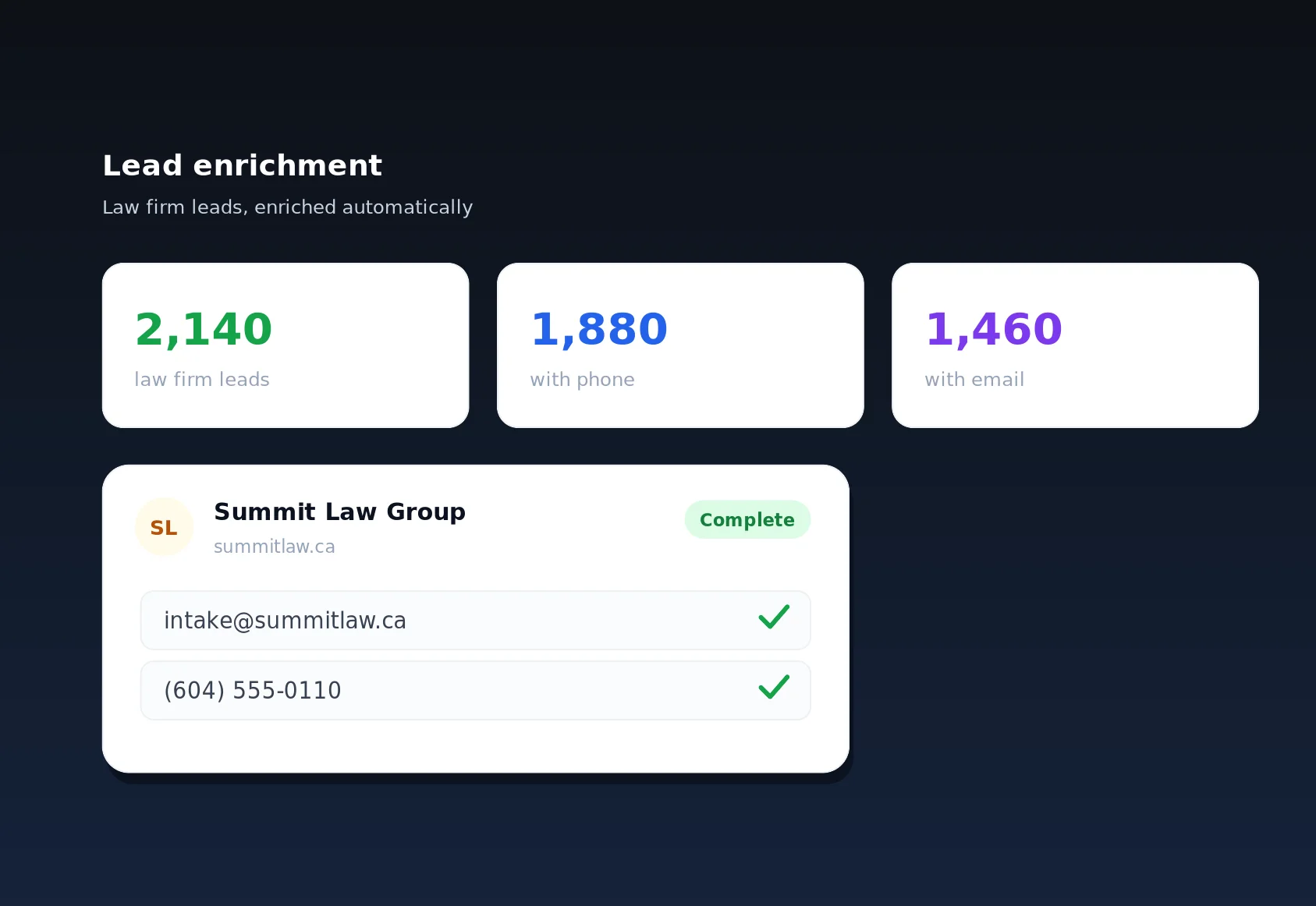
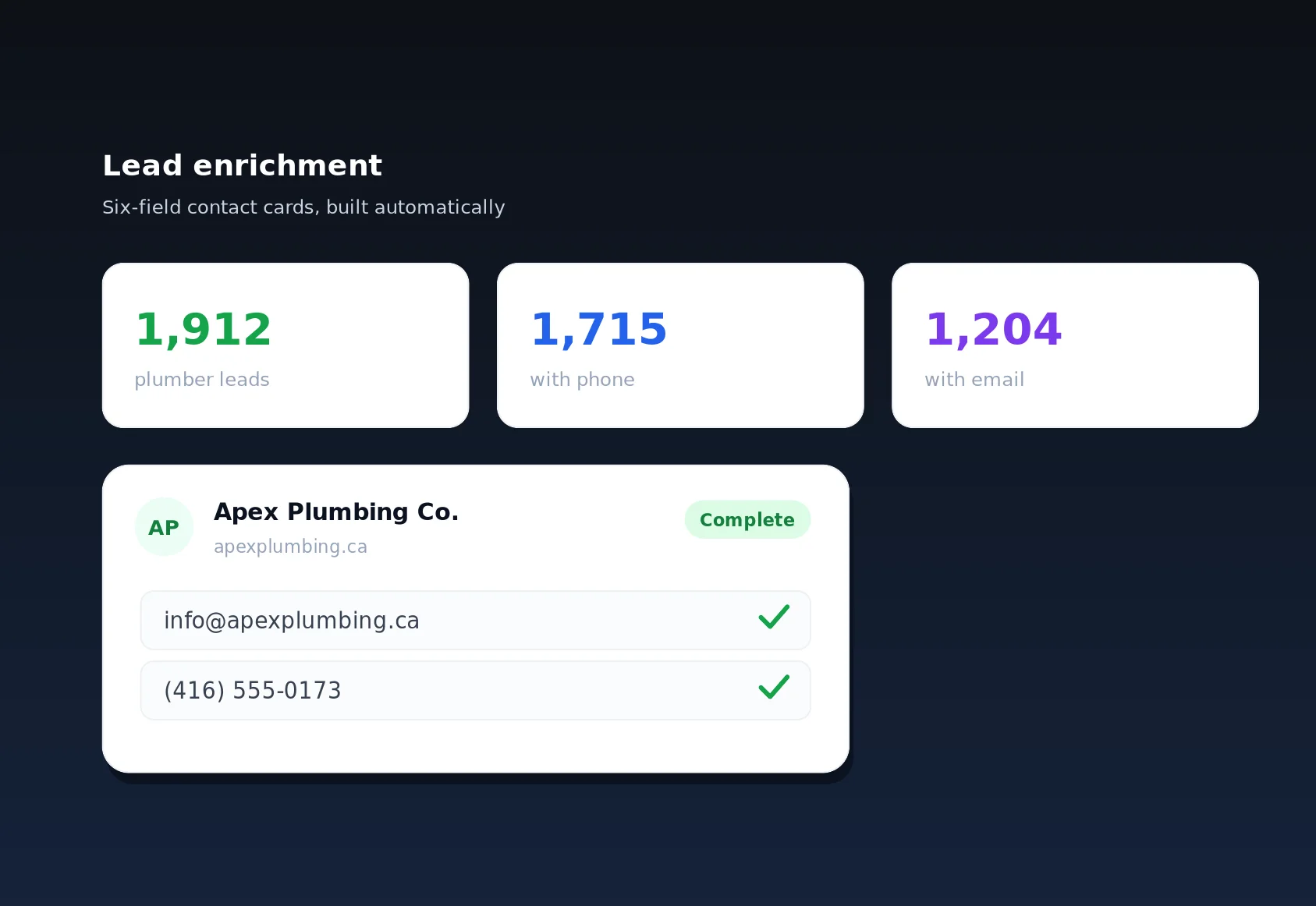
This is where the empty columns get filled. If a card has a website but no email or phone, the builder hands it to lead enrichment, which visits the business's own site through rotating anonymous proxies. Because the visit goes through a proxy pool, your real IP never leaks — you can enrich thousands of sites without your own address showing up in anyone's server logs. The enrichment reads the contact page, footer and schema markup to extract a genuine email and phone number straight from the source that the business itself publishes.
Step 4 — Normalise and categorise
Extracted data is cleaned: phone numbers are formatted, addresses are split into their geographic parts, and the business is assigned a category by LinkSpear's categorisation rules. A tradesperson site becomes a card tagged for the right vertical, so a campaign aimed at plumbers or electricians pulls exactly the right records.
Step 5 — File, flag and hand off
The finished card is written back to the master catalogue. Fields that could be filled are marked complete; fields that genuinely could not be found are flagged rather than faked, so your reps know the difference between "no email exists" and "email not yet found". From here the card is ready to enter a call queue, drive a backlink submission, or be exported.
Why source data from the business's own website
Most contact databases resell aggregated data that was scraped years ago from other databases. That is why so many purchased lists are full of disconnected numbers and role addresses that bounce. LinkSpear takes a different route: whenever it can, the full contact card builder pulls the email and phone from the business's own live website at the moment you need them.
The advantages are concrete:
- Freshness — you get the number the business is publishing today, not a cached value from an old data broker.
- Deliverability — an email lifted from a company's real contact page is far more likely to reach a human than a guessed pattern like first.last@domain.
- Anonymity — because enrichment runs through rotating anonymous proxies, you can gather this data at scale without exposing your own IP or tipping off anyone that you are prospecting them.
- Defensibility — the data comes from information the business chose to publish publicly, not from a shadowy resold list.
Full contact card builder versus the usual alternatives
Teams building local lead lists usually choose between three options: buy a static list, hire a VA to research manually, or use a generic email-finder tool. Each has a failure mode the builder is designed to avoid.
| Approach | Data freshness | Email & phone coverage | Deduplication | Your IP exposed? | Cost to scale |
|---|---|---|---|---|---|
| Bought static list | Often stale | Patchy, many bounces | None — you clean it | No, but data is resold | Low upfront, high waste |
| Manual VA research | Fresh | Good but slow | Manual, error-prone | Depends on VA | High — hourly labour |
| Generic email-finder | Mixed | Guessed patterns | None | Often yes | Per-credit, adds up |
| LinkSpear contact card builder | Live from source | Real email & phone from site | Automatic vs. master catalogue | No — rotating proxies | Flat plan, scales cleanly |
The difference is not just quality per record — it is that the builder folds sourcing, enrichment and deduplication into one pass, so you are not stitching three tools and a spreadsheet together to get a usable card.
The outcomes: what a complete card changes downstream
Complete data is not an end in itself; it is what makes everything after it work. When your contact cards are full, several things improve at once.
Reps spend their time calling, not researching
When a card already has a verified phone and a category, a rep opens the queue and dials. No hunting for numbers, no Googling the business mid-call. That alone can double the number of live conversations a rep has in a day, because the dead time between calls disappears.
Cold email actually lands
Emails sourced from the business's own site bounce far less than guessed addresses. Lower bounce rates protect your sending domain's reputation, which keeps the rest of your outreach out of spam folders.
Campaigns can be segmented precisely
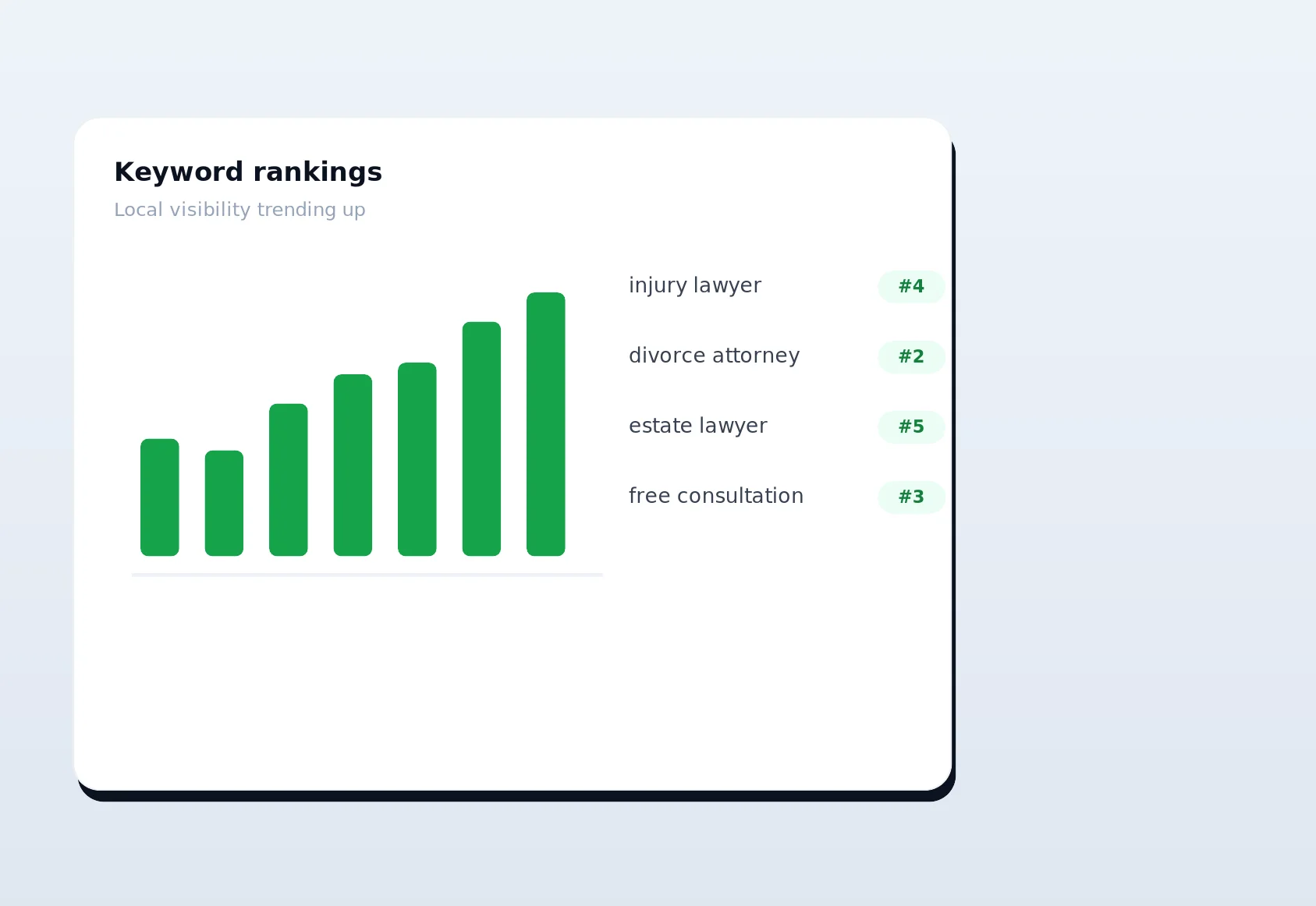
Because every card carries a clean category and clean geography, you can build a list of, say, roofing companies in a single province and route them into their own queue. Precise segmentation is what makes local outreach feel personal instead of blasted.
Backlink and citation work gets more accurate
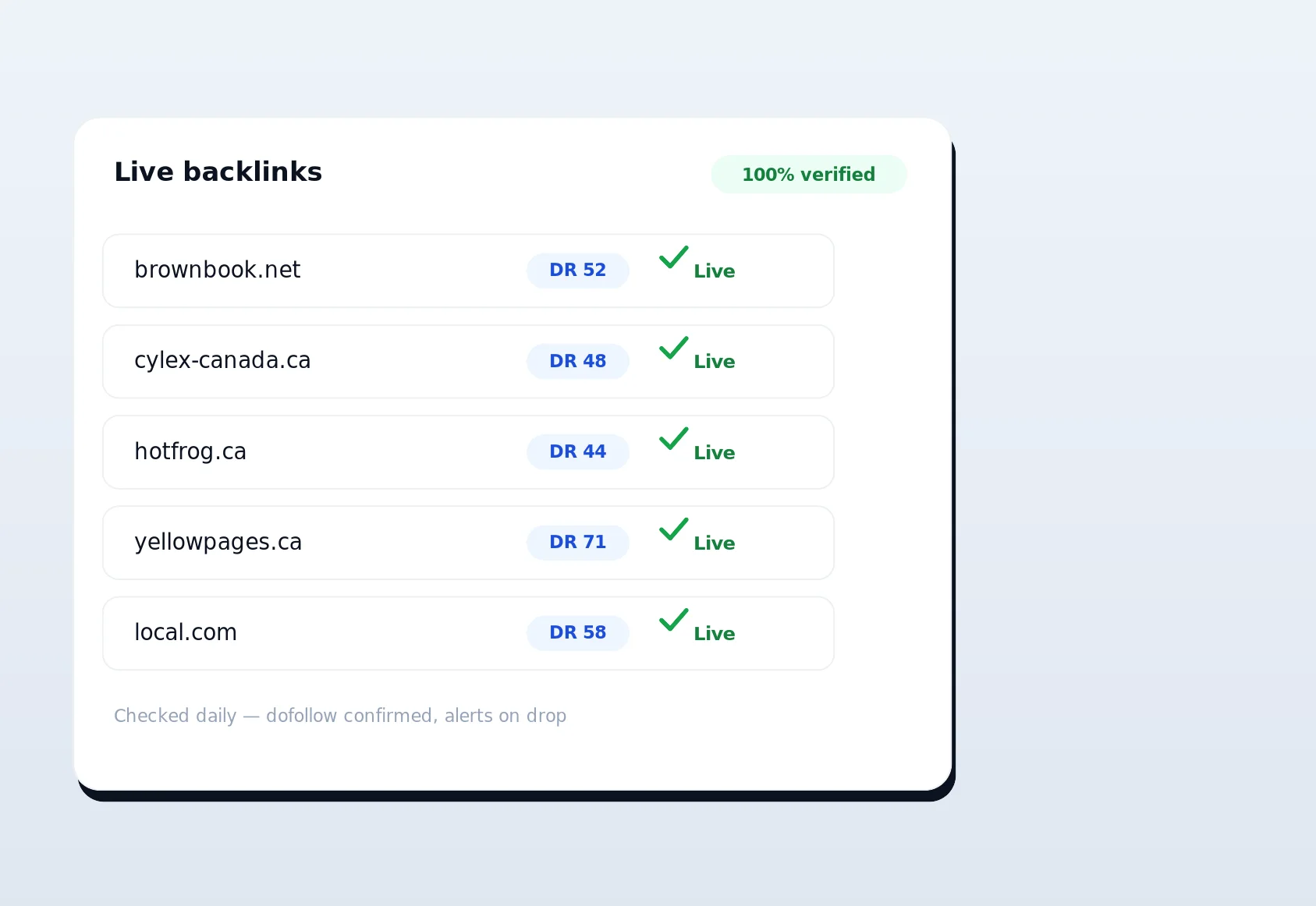
The same complete cards feed LinkSpear's automated directory backlink building. When a citation submission auto-fills from a card, having the correct name, address and phone (NAP) is what makes the citation count for local SEO. Inconsistent NAP data actively hurts rankings; complete, deduplicated cards keep it consistent everywhere.
Who the full contact card builder is for
The tool earns its keep for anyone whose work stalls on incomplete lead data.
- Small business owners doing their own outreach who cannot afford to buy and clean bad lists, and cannot spare hours researching each prospect.
- Sales teams that live in a call queue and need every record to be dial-ready the moment it appears.
- Marketing agencies running local campaigns for many clients, who need clean, categorised, per-region lead data at volume without exposing their own infrastructure.
- Local SEO specialists building citations and directory listings, for whom consistent NAP data across a complete contact card is the foundation of ranking work.
Agencies in particular benefit from LinkSpear's sub-accounts, where each client's contact cards stay isolated while the shared master catalogue prevents wasted effort across the whole book of business.
How it fits the wider LinkSpear workflow
The full contact card builder is the connective tissue of the platform. It sits between raw acquisition and every action you take on a lead. A typical flow looks like this: you scrape businesses from OpenStreetMap and YellowPages, the builder deduplicates and enriches them into complete cards, those cards flow into call queuing for your reps and into the citation-building extension for your SEO campaigns, and the outcomes feed back — verified links, logged calls, updated statuses — into the same master catalogue.
Everything reads from one clean source of truth. That is why rank tracking, keyword research, competitor backlink analysis and the rest of the toolkit stay coherent: they are all operating on the same well-built contact cards rather than fighting a dozen disconnected exports. Complete data upstream is what keeps the whole system honest downstream.
Data quality you can trust over time
A contact card is not built once and forgotten. Because the builder always merges into the master catalogue rather than overwriting or deleting, your data compounds in value instead of degrading. New signals refine existing cards; genuinely missing fields stay flagged so they can be revisited; and duplicates are collapsed the moment they appear. You end up with a lead asset that gets more complete and more reliable every week you use it, rather than a static file that ages the day you download it.

What happens when a field genuinely cannot be found
Honest data means admitting the gaps. No enrichment process finds an email for every single business, because some businesses simply do not publish one. The important design choice in the full contact card builder is that it never fabricates a field to look complete. If a plumber's website has a phone number but no email anywhere on it, the card is filled with the phone and the email slot is flagged as "not found" rather than stuffed with a guessed pattern.
That distinction matters more than it first appears. A guessed email that bounces damages your sending reputation and burns a lead; a clearly flagged empty field simply tells your rep to reach out by phone instead. Because flags are explicit, you can also filter your catalogue to "cards missing email" and re-run enrichment later, after a business has updated its site — the record is never abandoned, just parked until better data appears. This is the same principle that runs through the rest of the platform: data is preserved and refined, never quietly deleted or overwritten with something worse.
Over time this turns your catalogue into a living map of your market. You can see at a glance which segments have thin contact coverage and which are fully enriched, and prioritise your acquisition or manual-research effort accordingly instead of guessing where the holes are.
Building cards at scale without getting blocked
Filling one contact card is easy. Filling ten thousand without your requests getting throttled, blocked or traced back to you is the hard part, and it is where most home-grown scrapers fall apart. LinkSpear handles the scale problem with the same proxy infrastructure that powers the rest of the platform: enrichment traffic is spread across a maintained pool of rotating anonymous proxies, so no single address hammers any one website and your own IP never appears in the loop.
The practical effect is that an agency can point the builder at an entire metro area's worth of local businesses and let it work through them steadily in the background. You are not babysitting a script, swapping proxies by hand, or worrying that a burst of requests will get your office IP banned from a directory you rely on. The builder paces itself, retries transient failures, and keeps every completed card flowing into the master catalogue where call queuing and your SEO campaigns can pick them up. Scale stops being a technical project and becomes a setting.
Start building complete contact cards free
Incomplete lead data is a tax you pay on every call and every campaign — in wasted rep hours, bounced emails and citations that never counted. The full contact card builder removes that tax by turning fragmentary listings into complete, deduplicated, call-ready records sourced from the businesses' own websites, all without ever exposing your IP. It is the difference between a spreadsheet you have to fix and a lead asset you can act on immediately. New users get a 14-day free trial on the Starter plan — no long-term commitment — so you can point LinkSpear at your own market, watch the cards fill themselves in, and hand your team leads that are ready to work from the very first call. Start your free trial today and see how many complete contact cards LinkSpear can build for your niche.