If you have ever built local citations by hand, you already know the trap: you write one great business description, then paste the exact same paragraph into fifty, a hundred, or two hundred directories. Spintax content variation exists to break that pattern. Instead of shipping identical copy everywhere, LinkSpear lets you author a single spintax template and generate a distinct, human-readable version of your description, tagline, and anchor text for every submission you make. The result is a backlink and citation footprint that reads like it was written by hand, one directory at a time, because effectively it was.
This page explains exactly what spintax is, how LinkSpear's engine turns your template into thousands of natural variations, the concrete SEO and outreach outcomes you can expect, who benefits most, and how it plugs into the wider LinkSpear workflow alongside automated directory backlink building and lead enrichment.
What is spintax content variation?
Spintax is a lightweight markup syntax for expressing many possible versions of a sentence inside a single line of text. You wrap interchangeable phrases in curly braces and separate the options with a pipe character. When the engine renders the template, it picks one option from each set, producing one finished, readable sentence. Spintax content variation is the practice of using that syntax deliberately, so that every citation, directory listing, or profile carries wording that is genuinely different from the last.
Here is the idea in its simplest form. A template like this:
{We are|We're proud to be} {a family-run|a locally owned} plumbing company {serving|based in} Austin.
can render as "We are a family-run plumbing company serving Austin," or "We're proud to be a locally owned plumbing company based in Austin," and six other combinations besides. That trivial example already yields eight unique outputs. Real templates nest options inside options and combine several sentences, so the number of possible variations climbs into the thousands or millions very quickly. The point is not to trick anyone; it is to avoid publishing the same block of text across hundreds of third-party sites, which reads as low-effort and duplicated.
Why duplicate descriptions hurt your local SEO
When you submit the identical paragraph to every directory, you create a large cluster of near-duplicate pages that all point back to you. Search engines are good at spotting boilerplate. Directories themselves increasingly de-duplicate or down-weight listings that match text they have already indexed elsewhere. And human editors who review submissions on higher-authority directories often reject copy that looks copy-pasted or spun poorly.
Diversifying your copy with spintax content variation addresses all three problems at once:
- Fewer duplicate-content signals. Each listing carries its own wording, so your citation profile looks organic rather than mass-produced.
- Higher acceptance rates. Editors and automated filters are far less likely to flag a submission that does not exactly match a description they have already seen.
- Natural anchor-text distribution. By spinning the anchor and surrounding sentence together, you avoid an unnatural pattern of the exact same anchor text repeating across every backlink.
- Better keyword coverage. Variations let you work in synonyms and long-tail phrasing that a single fixed description could never cover.
The goal is a citation footprint that a manual reviewer would assume was built slowly and carefully by a real person, because every individual listing genuinely stands on its own.
How LinkSpear's spintax engine works
LinkSpear ships a full spintax pipeline: an editor, a live preview, a uniqueness analyzer, and tight integration with the submission engine. Here is the flow, step by step.
Step 1: Write your master template
You start in the spintax editor with your business description, tagline, and any anchor-text sentences. Wrap your interchangeable phrases in {option A|option B|option C} syntax. You can nest spins inside spins for deeper variation, and you can reference stored variables like your business name, city, and category so those stay consistent while the surrounding language changes.
Step 2: Preview and validate the syntax
The live preview renders a fresh random variation every time you refresh, so you can read exactly what a directory will receive. The validator catches unbalanced braces, empty options, and orphaned pipes before they ever reach a submission, so you never ship a broken sentence with a stray bracket in it.
Step 3: Check the uniqueness score
The uniqueness analyzer estimates how many distinct outputs your template can produce and samples several renders to measure how different they are from one another. If two variations are too similar, you get a warning and a prompt to add more options at the low-variation points. This keeps you from a template that technically spins but produces near-identical results.
Step 4: Attach the template to a submission run
When you kick off a directory run, LinkSpear pulls a fresh render of your template for each site. The Chrome extension auto-fills that unique description into the submission form using your real browser and your real IP, so there are no automation footprints on the sites you are listing on.
Step 5: Track which variation went where
Every submission logs the exact rendered text alongside the target directory, so you always have a record of what was published on each site. If a listing is ever questioned or needs updating, you can see precisely what was sent.
A quick look at spintax syntax
You do not need to be a developer to use spintax, but a few patterns cover almost everything you will write. The table below shows the core building blocks.
| Pattern | What it does | Example |
|---|---|---|
{a|b|c} | Picks one of the listed options | {fast|reliable|affordable} → "reliable" |
| Nested spins | Spins inside another spin for deeper variety | {a {small|local} shop|a boutique} |
| Empty option | Sometimes includes a phrase, sometimes omits it | {|proudly }serving Denver |
| Variables | Keeps facts consistent while wording varies | {Call|Reach} {{business_name}} today |
| Sentence-level spin | Swaps whole sentences for maximum uniqueness | {We fix leaks fast.|Leaky pipe? We're on it.} |
Combine a handful of these across a three or four sentence description and you comfortably reach thousands of possible renders, each one grammatical and on-brand. The trick is to spin at the phrase and sentence level rather than swapping individual words. Swapping whole clauses keeps the output readable, while single-word thesaurus swaps are exactly what made old spinners produce garbage.
How to write spintax that reads like a human
The difference between spun copy that helps you and spun copy that embarrasses you comes down to craft. A few practical habits will keep every render sounding like a person wrote it on purpose.
Spin ideas, not words
Rather than writing {fast|quick|speedy|rapid} and hoping the sentence still works, rewrite the whole idea in two or three genuinely different ways: "We answer emergency calls within the hour" versus "Same-day service is the norm, not the exception." Each phrasing is something you would actually say out loud, so no render ever sounds stilted.
Keep your best claims in every version
If a fact matters, such as being licensed and insured or offering free estimates, do not bury it inside a spin where half your listings drop it. Put load-bearing selling points outside the braces, or spin only their phrasing, so every single directory listing still carries your strongest message.
Vary sentence order, not just wording
You can wrap two or three sentences in a top-level spin so that listings sometimes lead with your service area and sometimes lead with your specialty. Reordering the flow makes two renders feel structurally different, not just cosmetically reworded, which is what pushes your uniqueness score higher.
Read three or four renders before you run
The live preview exists so you can sanity-check the output. Refresh it a handful of times and read each result aloud. If any combination sounds awkward, that is a sign two of your options do not fit together, and you can fix the template before a single submission goes out.
A worked example: spinning a plumber's citation
To make this concrete, imagine a plumbing company building citations across two hundred local directories. Their master template might read like this:
{{business_name}} is {a licensed and insured|a fully licensed} plumbing company {serving|proudly serving} {{city}} and the surrounding area. {We handle everything from|Our team tackles} {emergency leaks and burst pipes|drain cleaning and water heater installs} {with same-day availability|around the clock}. {Call us today|Get in touch} for a free estimate.
One render becomes "Rapid Rooter is a licensed and insured plumbing company serving Austin and the surrounding area. We handle everything from emergency leaks and burst pipes with same-day availability. Call us today for a free estimate." A different directory receives "Rapid Rooter is a fully licensed plumbing company proudly serving Austin and the surrounding area. Our team tackles drain cleaning and water heater installs around the clock. Get in touch for a free estimate." Same business, same facts, same tone, completely different text. Multiply those options out and this single template covers all two hundred submissions without a single duplicate paragraph, while the business name and city stay locked through variables on every one. That is the entire value of spintax content variation in a nutshell: honest, on-brand copy that is never the same twice.
Concrete benefits and outcomes
Spintax is not a novelty feature; it changes the economics of citation building. Here is what teams actually get out of it.
- Write once, publish everywhere uniquely. You author a single template and it covers your entire directory campaign, instead of hand-editing every listing to avoid duplication.
- Higher approval and live-link rates. Unique, natural copy clears editorial review and duplicate filters more often, so more of your submissions actually go live and stay live.
- A cleaner backlink profile. Varied anchor text and surrounding language produce a link footprint that looks earned rather than blasted.
- Time back for your team. A campaign that used to mean rewriting descriptions for hours becomes a ten-minute template edit.
- Consistency where it matters. Your name, address, phone, and category stay locked via variables, protecting your NAP consistency even as the prose changes.
These outcomes compound over a campaign. On a single directory, the difference between unique and duplicate copy is small. Across two hundred citations, a template that lifts your acceptance rate even a few points means dozens more live links, and a link profile that reads as earned rather than blasted is worth far more per link. Because you build the template once and reuse it, that upside costs you almost no additional time.
Spun content the right way versus the wrong way
Spintax has a reputation problem because it was abused a decade ago by spammers who chained thesaurus-swapped garbage into unreadable text. LinkSpear's approach is deliberately different. The comparison below shows where the line sits.
| Dimension | Old-school spam spinning | LinkSpear spintax content variation |
|---|---|---|
| Who writes the options | Automated synonym swap on every word | You write every option; each reads naturally |
| Readability | Often broken and robotic | Every render is grammatical and on-brand |
| Facts (NAP) | Frequently mangled | Locked with variables, always consistent |
| Goal | Fool filters with volume | Avoid duplicate copy while staying honest |
| Submission method | Headless bots, obvious footprints | Real browser, real IP via the extension |
| Auditability | None | Every rendered listing is logged per site |
The distinction matters. Good spintax is a productivity tool for writing many honest variations of true statements about your business. It is not a way to manufacture keyword-stuffed filler, and the uniqueness analyzer plus the human-written option model are designed to keep you on the right side of that line.
Who spintax content variation is for
Any business or team that submits to more than a handful of directories will feel the benefit, but a few groups get outsized value.
- Marketing agencies managing citation campaigns for many clients at once. With agency sub-accounts, each client keeps its own template library, so you scale without pasting the same copy across every account.
- Multi-location businesses that need every location to read distinctly rather than as clones of one flagship listing.
- Local service businesses such as plumbers, electricians, and HVAC contractors who rely heavily on local citations and directory presence to rank in the map pack.
- In-house SEO teams who want the efficiency of automation without the duplicate-content risk that comes with copy-paste submissions.
If your growth depends on being found across dozens of local directories, spintax turns what was a tedious, error-prone chore into a repeatable, controllable process.
How it fits the wider LinkSpear workflow
Spintax is one link in a chain that takes you from a raw list of prospects all the way to live, ranking citations. Here is where it sits.
Before spintax: build and enrich your data
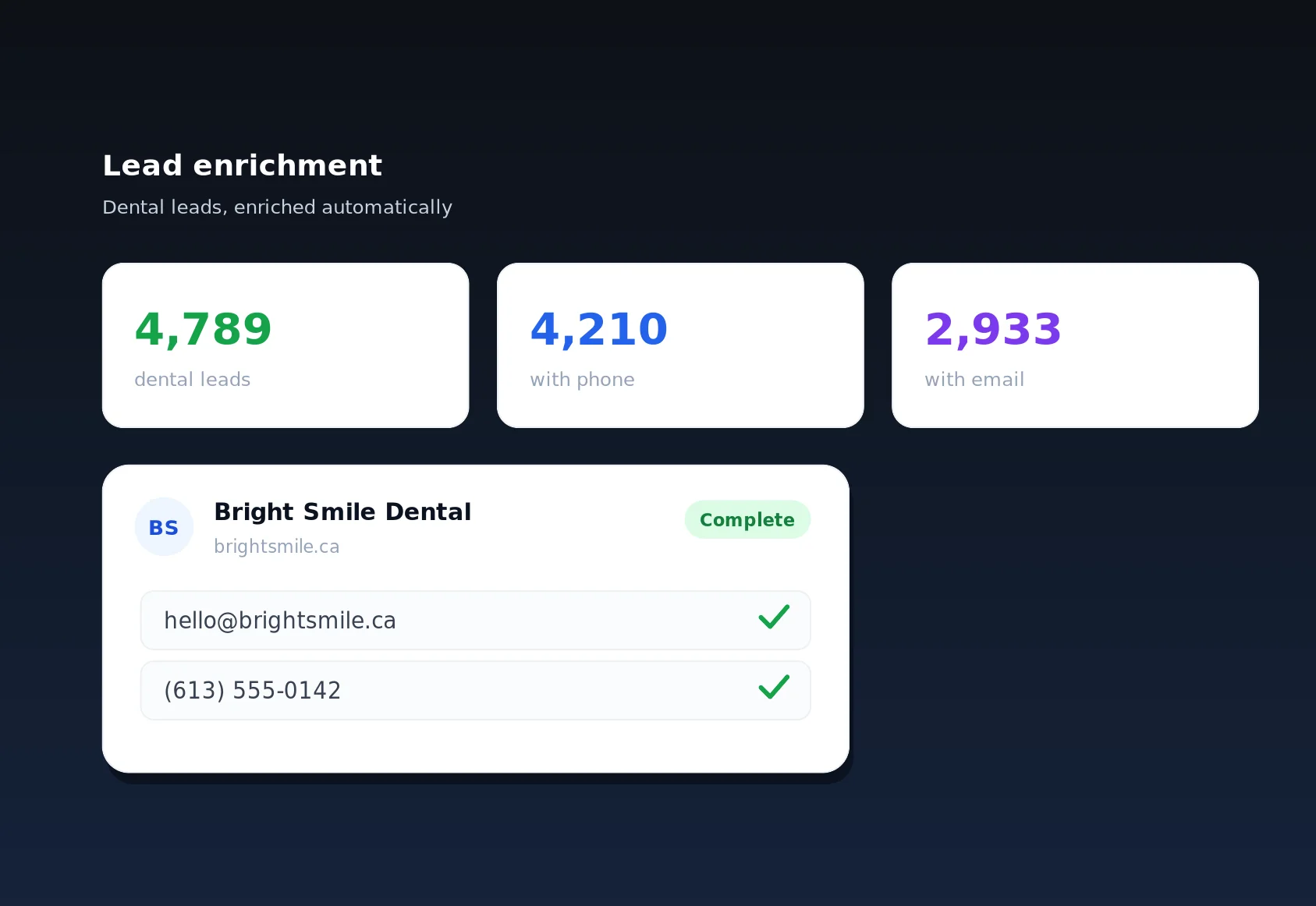
You begin by pulling businesses from the Local Business Directory or by scraping fresh leads from OpenStreetMap and YellowPages. Lead enrichment then visits each business's own website through rotating anonymous proxies to fill in missing emails and phone numbers, so your contact cards are complete before you do anything with them.
During: spin your submission copy
With your own business details in hand, you write your spintax template once. Every directory submission then draws a fresh, unique render, keeping your NAP consistent through variables while the surrounding language varies site to site.
After: submit, verify, and track
The Chrome extension auto-fills each unique description into directory forms using your real browser and IP. From there, live-link verification confirms your listings actually went live and stay live, rank tracking watches the movement in your target locations, and instant indexing nudges the new pages to get discovered faster. Spintax is the quiet piece in the middle that makes the whole citation-building motion look natural instead of mass-produced.
Getting started with spintax content variation
You can have a working template in minutes. Draft your description, wrap your interchangeable phrases in braces, lock your business name and city as variables, and watch the live preview and uniqueness score tell you when the template is varied enough to run. Then attach it to a directory campaign and let the extension handle the submissions one unique listing at a time.
The best way to understand what unique-at-scale citations do for your rankings is to build a template and run it against a real directory list. Every new LinkSpear account starts with a 14-day free trial on the Starter plan, with no charge to get going. Set up your first spintax template, spin a few hundred natural variations, and watch your directory submissions stop looking like copy-paste and start looking like they were written by hand for every single site. Start your free trial today and turn one description into an entire campaign of distinct, credible listings.